
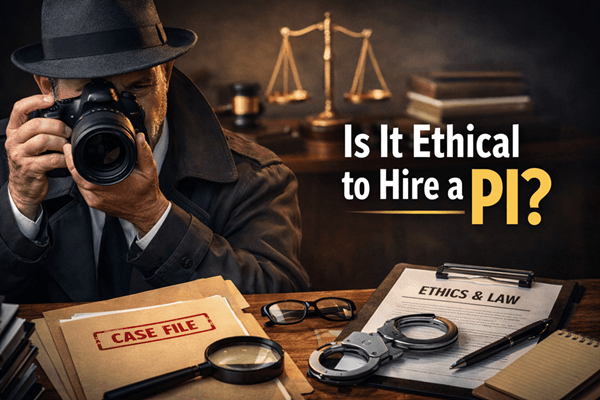
Private investigators often appear in films and television dramas as these mysterious figures that operate in the shadows. There’s definitely a shady vibe to them.
In reality, professional private investigators work within strict legal and ethical boundaries, helping individuals, businesses and organisations uncover facts, gather evidence and resolve complex issues.
But even so, many people considering hiring a private investigator ask an important question: is it ethical to hire a PI?
In most cases, hiring a reputable private investigator is entirely ethical, particularly when you’re seeking the truth in situations where you have legitimate concerns or interests to protect. But there’s definitely some nuances to consider.
Understanding the Role of a Private Investigator
A private investigator’s job is to gather information legally and professionally. They may conduct surveillance, trace individuals, perform background checks, investigate fraud, locate debtors or gather evidence for legal proceedings.
Private investigators are often instructed by:
- Private individuals who are concerned about a partner’s behaviour
- People who are trying to locate estranged family members
- Businesses investigating employee misconduct
- Solicitors who need evidence for court cases
- Local authorities investigating fraud or licensing breaches
In each of these situations, the investigator’s role is not to make judgments, but to establish facts and gather evidence.
When Hiring a PI Is Clearly Ethical
There are many situations where hiring a private investigator can be comfortably seen as an ethical decision.
For example, someone may suspect that an ex-partner is cohabiting with a new partner while continuing to receive financial support based on claims that they live alone. In this case, obtaining evidence could have significant legal and financial implications.
Or how about businesses that suspect fraudulent activity, such as exaggerated injury claims, employee theft or false sickness absences? Investigating these concerns helps protect both the company and its honest employees.
Families may also hire investigators to trace missing relatives or reconnect with loved ones. In these situations, a PI can provide valuable assistance while handling sensitive matters with care and discretion.
Where there is a genuine need to establish the truth or protect legitimate interests, hiring a private investigator is generally considered the right thing to do.
The Importance of Legitimate Purpose
The key consideration when you’re talking about ethics of private investigation tends to be the reason behind the investigation.
Hiring a PI because you’re concerned about potential fraud, dishonesty or wrongdoing is very different from hiring someone simply to invade another person’s privacy out of curiosity or spite.
Good investigators, ones that are trustworthy, will usually assess whether a client’s request has a legitimate basis before accepting instructions. If a proposed investigation appears to be malicious, harassing or unlawful, a professional investigator should decline the work.
Ethics and legality often overlap. A legitimate purpose helps to make sure that any investigation remains both lawful and morally justifiable.
Privacy Concerns and Ethical Boundaries
One of the most common concerns surrounding private investigation work is privacy.
Everyone has a reasonable expectation of privacy in certain situations. Ethical investigators understand this, and are careful to operate within the law. They don’t have special powers that allow them to access private bank accounts, listen to phone calls, hack computers or obtain confidential records unlawfully. Despite what journalists and some investigators tried to get away with over the last couple of decades…
Instead, professional investigators gather information through lawful methods such as observation in public places, open-source research and other legally permitted investigative techniques.
The fact that an investigation may involve observing someone’s activities doesn’t automatically make it unethical. Courts, employers and regulatory bodies often rely on evidence gathered through legal surveillance when resolving disputes or investigating misconduct.
The ethical line is crossed when privacy is unlawfully or unnecessarily invaded. This is why choosing a reputable agency is so important.
With That in Mind, Is Surveillance Ethical?
Surveillance is perhaps the area of private investigation that attracts the most debate.
Some people view surveillance as intrusive, while others see it as a necessary tool for uncovering the truth.
The ethics of surveillance usually depend on proportionality. If there is a genuine concern about fraud, dishonesty or misconduct, observing someone’s public activities can be a reasonable and ethical way to establish facts.
For example, if a business has evidence suggesting an employee is falsely claiming long-term sickness while working elsewhere, surveillance may provide the evidence that confirms or disproves those suspicions.
Likewise, a person who suspects a partner of infidelity may seek clarity rather than relying on assumptions or rumours. Better to know that guess, right?
Professional investigators focus on gathering factual evidence rather than encouraging confrontation or speculation. Their role is to document events accurately and objectively.
Ethical Responsibilities of the Investigator
Ethical investigations don’t rely solely on the client’s intentions. That’s an important distinction to make. The investigator also has important responsibilities, and clients should be making sure they only hire someone who can demonstrate their willingness to work within these boundaries.
A professional PI should:
- Operate within the law
- Respect privacy rights
- Conduct investigations proportionately
- Present evidence honestly
- Avoid misleading clients
- Refuse unlawful or unethical requests
- Maintain confidentiality
Good investigators understand that their reputation depends on integrity. Evidence gathered improperly may be unusable and could even expose both the investigator and client to legal consequences.
Common Misconceptions About Private Investigators
Many ethical concerns stem from misconceptions about what private investigators actually do.
Television dramas often portray investigators breaking into buildings, planting listening devices or accessing confidential databases. Can you imagine if this was all true? These activities would generally be illegal and are not part of legitimate private investigation work. Instead, PIs would be getting locked up themselves.
Understanding this distinction often helps people feel more comfortable about engaging a PI’s services.
Questions to Ask Before Hiring a PI
If you’re considering hiring a private investigator and are concerned about ethics, it’s worth asking a few questions before proceeding.
These might include:
- Is my reason for hiring an investigator legitimate?
- Will the investigation be conducted legally?
- Does the agency have a professional reputation?
- Are the proposed methods proportionate to the issue?
- Will my information remain confidential?
A reputable investigator should be happy to discuss these points and explain how they intend to conduct the investigation.
The Bottom Line
In most cases, hiring a private investigator is entirely ethical when there is a reasonable need to establish facts, protect legal rights or investigate suspected wrongdoing. Ethical concerns typically arise not from the profession itself, but from the motives behind an investigation or the methods used to carry it out.
Professional private investigators provide a valuable service by helping individuals, businesses and organisations make informed decisions based on evidence rather than suspicion.
When conducted in the right way (i.e. lawfully, proportionately and with respect for privacy), private investigation work can be both ethical and beneficial.
If you have concerns that require professional investigation, or would like confidential advice about your situation, call EJM Investigations on 01772 334700.